Creativity Lost Touch
Een handgemaakte poster over wat er uit ontwerp verdwijnt wanneer snelheid, controle en digitale perfectie het proces gaan bepalen.
Jan Freerk Schilstra
Poster Design
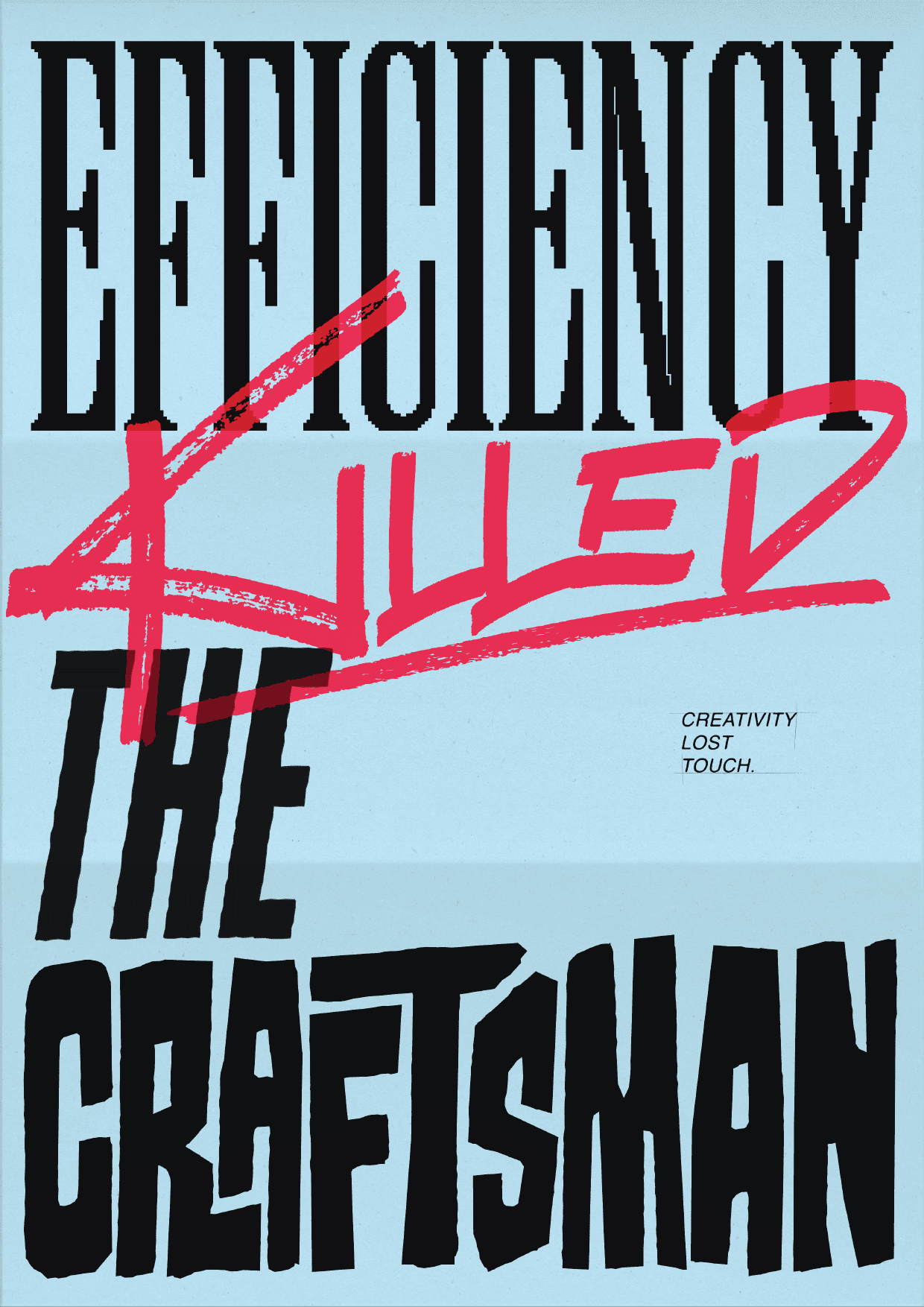
Deze poster vormt het tastbare eindpunt van mijn afstudeerproject Creativity Lost Touch. Elk deel van de tekst is opgebouwd met een andere analoge techniek, waaronder zeefdruk, houtdruk en handmatige bewerking. De verschillen in structuur, dekking en registratie blijven bewust zichtbaar. Juist daarin zit het onderwerp van het werk: wat verdwijnt er wanneer ontwerp steeds sneller, gladder en voorspelbaarder wordt? De poster laat sporen van het maakproces zien en geeft ruimte aan fouten, weerstand en toeval. Zo draagt de vorm dezelfde boodschap als de woorden.
Schrijf je in voor de nieuwsbrief
Krijg updates over nieuw werk, projecten of blogs.
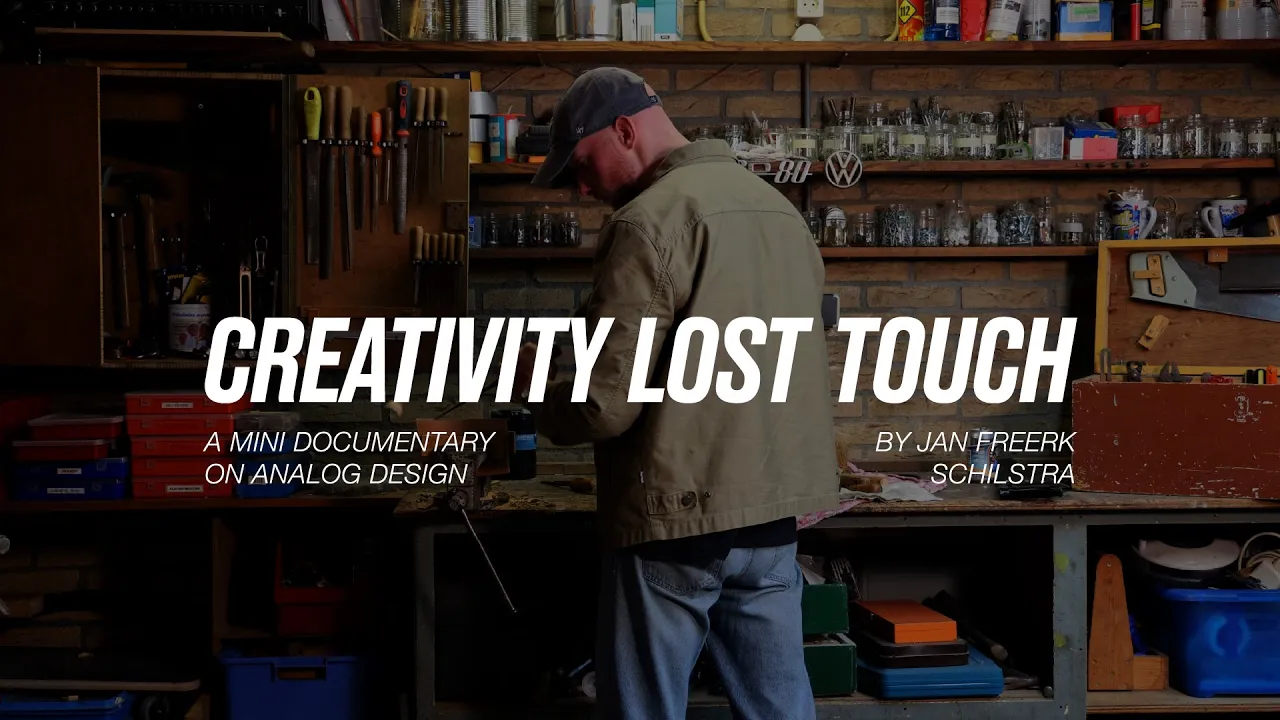
De poster vormt het visuele hart van Creativity Lost Touch. In de mini-documentaire zie je hoe hij met traditionele technieken tot stand kwam en hoor je het verhaal achter de boodschap.
Bekijk de mini-documentaire hieronder, of lees de blog:
Creativity Lost Touch
“Flaws are human, and the attraction of art is the humanity held in it. If we were machinelike, the art wouldn’t resonate. It would be soulless.”
- Rick Rubin, The Creative Act: A Way of Being
Up until the late ’80s, graphic design was a very tactile craft. In contrast to the digital way of working we’re now familiar with, it used to be a domain of handwork and physical tools. The process was slow and thoughtful, and every finished piece carried marks and imperfections that told the story of the creation process that brought it to be. Those imperfections weren’t mistakes, but a signature left by the way it was made.
When design shifted to digital, that all changed. We traded the slow, deliberate nature of the craft for efficiency and precision. The tools we now use no longer leave their marks; they erase them.
Stepping away from the screen
My name is Jan Freerk Schilstra. I’m a graphic designer, and for this project, instead of my trusty MacBook, traditional tools became my way of working. I made that choice to reconnect with a more grounded, intentional way of making.
Growing up, I loved solving problems with whatever I had at hand. But as a graphic designer, I never fully embraced that hands-on way of creating. This project allowed me to tap into that inventive approach, blending it with the design knowledge and taste I’ve developed in the meantime. At first, I planned to do this project in a printmaking studio. Instead, I chose to work in my own messy workshop, without any fancy equipment. Just me, my tools and my inventiveness.
The distance between maker and work
I don’t think it’s healthy for creatives to spend all their time behind a screen. Digital tools are amazing, indispensable even, but they can also be limiting in ways that aren’t always obvious. There’s always that glass pane between you and your work, and on top of that, the process is very streamlined.
There is little sensory engagement or risk involved, which can make creating feel distant and passive, with a lesser sense of actually making something. When I click my mouse twice, a pixel-perfect line appears, and when I don’t like it, I press undo. Handmade work is different. It’s unpredictable and can be messy, but that’s part of the appeal. Mistakes happen, and they can lead to new ideas - ones you’d never find by pressing undo until you’ve drawn the perfect line. I’ll gladly take the risk of that unpredictability when I’m working on slow, unpressured projects like this. Of course, when I’m working on a logo for a client with a deadline, I’ll reach for my MacBook because it’s the right tool for the job.
Digital tools have made design far more efficient, but also a bit more machinelike when compared to the analog way of working. By “machinelike”, I mean that the digital approach tends to sacrifice organic depth to make room for precision, efficiency and speed, especially with the rise of AI we’re experiencing now. Though the analog era laid the foundation for modern digital design, the two approaches are worlds apart.
Looking beyond digital
This project isn’t about trading your pen tool for a hammer and chisel or leaving digital behind. It’s about looking beyond it. In the professional world, digital is the norm, as it should be, because it fits. The precision and efficiency it offers align perfectly with the demands of that field. Still, there’s space outside those boundaries: a space where analog’s imperfection, depth and unpredictability breathe life back into the process. It’s a space many seem to overlook because all spotlights are on technological developments. That space is worth discovering. It broadens your skills as a creator and reintroduces a kind of humanity into the process that speaks to the soul of both the creator and the work.
“Flaws are human, and the attraction of art is the humanity held in it. If we were machinelike, the art wouldn’t resonate. It would be soulless.”
- Rick Rubin
Creativity Lost Touch
“Flaws are human, and the attraction of art is the humanity held in it. If we were machinelike, the art wouldn’t resonate. It would be soulless.”
- Rick Rubin, The Creative Act: A Way of Being
Up until the late ’80s, graphic design was a very tactile craft. In contrast to the digital way of working we’re now familiar with, it used to be a domain of handwork and physical tools. The process was slow and thoughtful, and every finished piece carried marks and imperfections that told the story of the creation process that brought it to be. Those imperfections weren’t mistakes, but a signature left by the way it was made.
When design shifted to digital, that all changed. We traded the slow, deliberate nature of the craft for efficiency and precision. The tools we now use no longer leave their marks; they erase them.
Stepping away from the screen
My name is Jan Freerk Schilstra. I’m a graphic designer, and for this project, instead of my trusty MacBook, traditional tools became my way of working. I made that choice to reconnect with a more grounded, intentional way of making.
Growing up, I loved solving problems with whatever I had at hand. But as a graphic designer, I never fully embraced that hands-on way of creating. This project allowed me to tap into that inventive approach, blending it with the design knowledge and taste I’ve developed in the meantime. At first, I planned to do this project in a printmaking studio. Instead, I chose to work in my own messy workshop, without any fancy equipment. Just me, my tools and my inventiveness.
The distance between maker and work
I don’t think it’s healthy for creatives to spend all their time behind a screen. Digital tools are amazing, indispensable even, but they can also be limiting in ways that aren’t always obvious. There’s always that glass pane between you and your work, and on top of that, the process is very streamlined.
There is little sensory engagement or risk involved, which can make creating feel distant and passive, with a lesser sense of actually making something. When I click my mouse twice, a pixel-perfect line appears, and when I don’t like it, I press undo. Handmade work is different. It’s unpredictable and can be messy, but that’s part of the appeal. Mistakes happen, and they can lead to new ideas - ones you’d never find by pressing undo until you’ve drawn the perfect line. I’ll gladly take the risk of that unpredictability when I’m working on slow, unpressured projects like this. Of course, when I’m working on a logo for a client with a deadline, I’ll reach for my MacBook because it’s the right tool for the job.
Digital tools have made design far more efficient, but also a bit more machinelike when compared to the analog way of working. By “machinelike”, I mean that the digital approach tends to sacrifice organic depth to make room for precision, efficiency and speed, especially with the rise of AI we’re experiencing now. Though the analog era laid the foundation for modern digital design, the two approaches are worlds apart.
Looking beyond digital
This project isn’t about trading your pen tool for a hammer and chisel or leaving digital behind. It’s about looking beyond it. In the professional world, digital is the norm, as it should be, because it fits. The precision and efficiency it offers align perfectly with the demands of that field. Still, there’s space outside those boundaries: a space where analog’s imperfection, depth and unpredictability breathe life back into the process. It’s a space many seem to overlook because all spotlights are on technological developments. That space is worth discovering. It broadens your skills as a creator and reintroduces a kind of humanity into the process that speaks to the soul of both the creator and the work.
“Flaws are human, and the attraction of art is the humanity held in it. If we were machinelike, the art wouldn’t resonate. It would be soulless.”
- Rick Rubin
Creativity Lost Touch
“Flaws are human, and the attraction of art is the humanity held in it. If we were machinelike, the art wouldn’t resonate. It would be soulless.”
- Rick Rubin, The Creative Act: A Way of Being
Up until the late ’80s, graphic design was a very tactile craft. In contrast to the digital way of working we’re now familiar with, it used to be a domain of handwork and physical tools. The process was slow and thoughtful, and every finished piece carried marks and imperfections that told the story of the creation process that brought it to be. Those imperfections weren’t mistakes, but a signature left by the way it was made.
When design shifted to digital, that all changed. We traded the slow, deliberate nature of the craft for efficiency and precision. The tools we now use no longer leave their marks; they erase them.
Stepping away from the screen
My name is Jan Freerk Schilstra. I’m a graphic designer, and for this project, instead of my trusty MacBook, traditional tools became my way of working. I made that choice to reconnect with a more grounded, intentional way of making.
Growing up, I loved solving problems with whatever I had at hand. But as a graphic designer, I never fully embraced that hands-on way of creating. This project allowed me to tap into that inventive approach, blending it with the design knowledge and taste I’ve developed in the meantime. At first, I planned to do this project in a printmaking studio. Instead, I chose to work in my own messy workshop, without any fancy equipment. Just me, my tools and my inventiveness.
The distance between maker and work
I don’t think it’s healthy for creatives to spend all their time behind a screen. Digital tools are amazing, indispensable even, but they can also be limiting in ways that aren’t always obvious. There’s always that glass pane between you and your work, and on top of that, the process is very streamlined.
There is little sensory engagement or risk involved, which can make creating feel distant and passive, with a lesser sense of actually making something. When I click my mouse twice, a pixel-perfect line appears, and when I don’t like it, I press undo. Handmade work is different. It’s unpredictable and can be messy, but that’s part of the appeal. Mistakes happen, and they can lead to new ideas - ones you’d never find by pressing undo until you’ve drawn the perfect line. I’ll gladly take the risk of that unpredictability when I’m working on slow, unpressured projects like this. Of course, when I’m working on a logo for a client with a deadline, I’ll reach for my MacBook because it’s the right tool for the job.
Digital tools have made design far more efficient, but also a bit more machinelike when compared to the analog way of working. By “machinelike”, I mean that the digital approach tends to sacrifice organic depth to make room for precision, efficiency and speed, especially with the rise of AI we’re experiencing now. Though the analog era laid the foundation for modern digital design, the two approaches are worlds apart.
Looking beyond digital
This project isn’t about trading your pen tool for a hammer and chisel or leaving digital behind. It’s about looking beyond it. In the professional world, digital is the norm, as it should be, because it fits. The precision and efficiency it offers align perfectly with the demands of that field. Still, there’s space outside those boundaries: a space where analog’s imperfection, depth and unpredictability breathe life back into the process. It’s a space many seem to overlook because all spotlights are on technological developments. That space is worth discovering. It broadens your skills as a creator and reintroduces a kind of humanity into the process that speaks to the soul of both the creator and the work.
“Flaws are human, and the attraction of art is the humanity held in it. If we were machinelike, the art wouldn’t resonate. It would be soulless.”
- Rick Rubin